Uncontrolled rolling or swiveling poses severe safety risks, accelerates equipment wear, and creates workflow bottlenecks across commercial and industrial environments. Relying on ad-hoc stopping methods, like rubber wedges or scrap wood, directly causes compliance hazards and daily operational inefficiencies. Facility managers need a reliable, permanent way to secure mobile equipment under dynamic loads. Upgrading to the correct locking mechanism heavily reduces workplace liability, improves operator ergonomics, and protects high-value cargo from accidental collision damage. This article provides a definitive guide to diagnosing movement issues so you can confidently choose the right hardware. We differentiate between various locking mechanisms and evaluate standard versus heavy-duty solutions for any Caster Wheel application. You will discover how to retrofit existing carts, overcome hidden design constraints, and implement industry-proven best practices for stabilizing massive payloads.
Key Takeaways
Identifying the difference between "swivel locks" (restricting rotation) and "wheel brakes" (stopping rolling) is the first step in hardware selection.
Standard caster brakes are not rated for holding loads on inclines; high-risk applications require directional locks or floor locks.
Heavy equipment stability is best achieved through a combination of locking mechanisms (e.g., two total-lock swivels paired with two fixed-axle wheels) rather than applying single brakes to all four corners.
Hidden or skirted equipment designs require specific hardware adaptations, such as threaded inserts, to ensure brakes remain accessible without compromising aesthetics.
Swivel Locks vs. Wheel Brakes: Defining the Mechanical Requirement
Operators frequently use the terms "brakes" and "locks" interchangeably. This confusion leads to purchasing incorrect hardware. You must precisely diagnose the movement issue before modifying any equipment. We recommend observing the cart under load. Does it drift sideways when pushed? It needs a swivel lock. Does it roll away down a slight slope? It needs a wheel brake.
Movement Diagnosis Chart
Observed Problem |
Force Type |
Required Hardware Solution |
Cart drifts left or right during transit |
Directional Pivoting |
Swivel Lock |
Cart moves forward or backward while parked |
Forward Momentum |
Wheel Brake |
Cart shifts entirely out of position on uneven floors |
Combination |
Total Lock Mechanism |
Swivel Locks Explained: A swivel lock focuses entirely on steering. It restricts the rig from pivoting. Manufacturers usually design these as hand-activated or foot-activated metal rings. You turn or step on the mechanism, and metal tabs engage into precise notches on the raceway. This action instantly converts a 360-degree pivoting wheel into a rigid one. You gain complete control for straight-line travel. Facilities use swivel locks heavily on long hospital corridors and warehouse picking routes to prevent fishtailing.
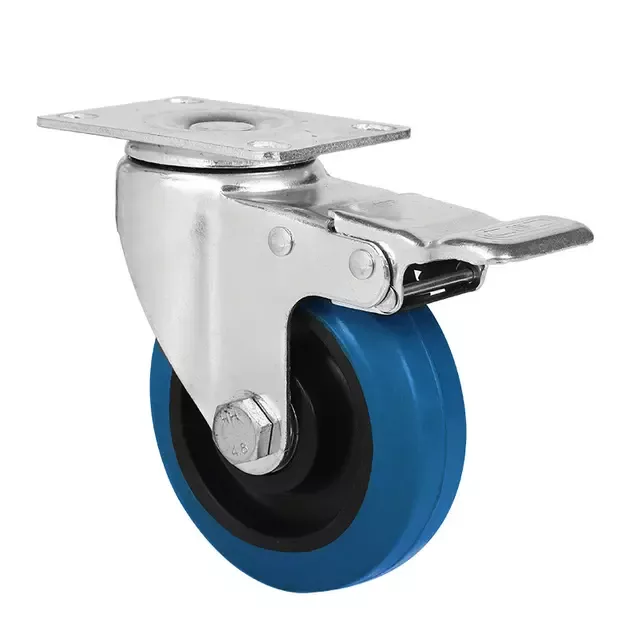
Wheel Brakes Explained: Wheel brakes ignore the steering rig. They focus purely on stopping forward and backward momentum. These mechanisms apply heavy physical friction directly to the wheel hub or the outer tire tread. When an operator engages the brake pedal, a metal arm clamps down. This friction overcomes the rolling momentum, keeping the cart parked safely.
The Total Lock Advantage: Many modern industrial setups demand maximum stationary security. Standard brakes or swivel locks alone leave a margin for error. Total lock mechanisms provide a dual-action solution. When you press the total lock pedal, the internal mechanism simultaneously clamps the wheel tread and locks the swivel raceway. The entire assembly becomes entirely immobile. We strongly recommend total lock systems for workbenches, scaffolding, and precision manufacturing equipment.
Integrated Braking Systems for Industrial Caster Wheels
Choosing an integrated braking system depends heavily on your load profile and operational environment. Sourcing Industrial Caster Wheels requires matching the OEM braking mechanism to your daily stress levels. A system rated for office furniture will fail catastrophically under heavy warehouse payloads.
We break down solution categories by their mechanical design and ideal applications:
Friction / Cam Brakes: These are highly cost-effective mechanisms. Operators activate them via a side pedal. The pedal forces a metal cam or washer against the side of the wheel hub. They work well for light-to-medium loads. However, they possess a critical flaw. As the wheel hub material wears down over time, the cam loses grip. You should avoid cam brakes for heavy-duty applications.
Tread Lock Brakes: Engineers consider tread locks the gold standard for industrial environments. The brake pedal drives a textured metal shoe directly into the tire tread. This provides positive engagement. Because the shoe bites into the rubber or polyurethane tread, it creates massive stopping power. They handle heavy loads easily and resist vibration loosening.
Compression / Decompression Brakes: These represent specialized, weight-activated systems. They dominate the office seating and medical stool markets. Compression brakes lock the wheel automatically when someone sits down. Decompression brakes do the exact opposite; they lock when unweighted, ensuring a stool does not roll away when an operator stands up quickly. They operate flawlessly indoors but cannot handle rugged factory debris.
Dead Man’s Brakes: These deliver high-security, fail-safe performance. The vehicle remains permanently locked by default. An operator must actively squeeze a release lever on the handle to permit movement. If the operator trips or releases the handle, the system instantly clamps the wheels. They are crucial for heavy-duty injury prevention, especially when moving massive parts near ramps or loading docks.
Best Practice: Always inspect tire tread before relying on tread lock brakes. Flattened or worn polyurethane significantly reduces braking efficiency. Replace heavily worn wheels to maintain holding power.
Floor Locks: The High-Frequency Ergonomic Alternative
Sometimes, wheel-mounted brakes fail to meet workflow efficiency needs. High-frequency loading zones require rapid stabilization. In these scenarios, you should abandon independent wheel brakes in favor of centrally mounted floor locks.
Evaluation Criteria: You must evaluate your daily cart usage. If operators stop and start a cart thirty times an hour, manually locking four separate corners causes severe delays. Floor locks mount directly to the bottom center of the cart frame, entirely separate from the wheels. A single press of a heavy-duty pedal deploys a high-friction rubber pad against the concrete.
Understanding the Total Cost of Ownership (TCO) and Return on Investment (ROI) drivers helps justify the hardware upgrade:
Efficiency: A single pedal press stabilizes an entire cart. You eliminate the need for operators to walk around the cart perimeter checking individual wheels. This reclaims hours of lost productivity over a fiscal quarter.
Safety: Floor locks prevent workers from bending down or reaching awkwardly under heavy equipment. By keeping operators upright, facilities directly reduce workplace ergonomic injuries and lower worker compensation claims.
Implementation Realities: You must understand the physics of a floor lock. Floor locks do not function as jacks. They do not lift the cart off the ground. Instead, they apply localized downward friction against the floor. To function correctly, the top plate height of the floor lock must perfectly match the existing rig. Most manufacturers standardize on a 4"x4.5" top plate dimension. This specific measurement ensures the floor lock aligns precisely alongside standard 2-inch wide industrial wheels. If you install a mismatched floor lock, it will either scrape the ground during transit or fail to touch the floor when deployed.
Retrofitting Existing Equipment: How to Lock Castor Wheels You Already Own
Facility managers often struggle with inherited equipment. You might possess expensive carts lacking proper stopping mechanisms. While operators frequently resort to wheel chocks, stabilizing blocks, or rubber floor mats, these offer only temporary relief. Rubber chocks degrade quickly under industrial stress. Permanent structural fixes require proper hardware retrofits.
Installing Aftermarket Locks:
Upgrading plate-mount rigs requires mechanical precision. Follow these steps to ensure a secure, permanent retrofit:
Measure Top Plate Dimensions: Flip the cart safely. Measure the bolt hole spacing on the existing rig. Identifying hardware compatibility prevents wasted purchases. Standard heavy-duty rigs commonly utilize a 4-1/2 x 6-1/4 top plate.
Source Compatible Hardware: Purchase field-installable swivel locks or aftermarket brake kits matching your plate dimensions.
Clean and Prep: Remove dirt and grease from the raceway. Apply a commercial thread-locking fluid to your mounting bolts. This prevents vibration from shaking the new hardware loose.
Align the Locking Ring: For swivel locks, align the notched ring exactly under the top plate. Ensure the activation tab extends past the rig edge for easy foot access.
Torque the Bolts: Tighten bolts in a star pattern. This distributes the pressure evenly and prevents plate warping. Test the engagement several times before returning the cart to service.
Replacing Wheels with Leg Levelers:
Some applications rarely require movement. Large server racks, 3D printers, and custom CNC tables might sit stationary for months. In these cases, wheel brakes still permit micro-vibrations. Swapping the entire assembly out for adjustable leg levelers provides a safer, zero-roll permanent baseline. Leveling feet use thick threaded stems and padded bases. They isolate vibration completely and allow you to perfectly level equipment on uneven shop floors.
Implementation Challenges: Enclosed Designs and Heavy Loads
Retrofitting standard flatbed carts poses few problems. However, specialized equipment presents unique mechanical challenges. You must adapt your strategy when dealing with enclosed panels or massive weight ratings.
The Hidden Caster Problem:
Custom cabinets, arcade machines, and retail display kiosks frequently utilize decorative skirts. These wooden or metal panels drop down close to the floor to hide the structural framework. While aesthetically pleasing, skirts block foot and hand access to brake pedals. Operators cannot reach the locking mechanism.
Many fabricators mistakenly attempt dangerous top-down drilling. They bore holes through the equipment floor to access the brakes with a rod. This compromises structural integrity and creates a frustrating user experience. Instead, you should adapt the outer shell.
Utilize these non-destructive access solutions:
Threaded Inserts: Remove the lower front panel section. Install brass threaded inserts into the framework. You can securely attach the panel using machine screws. When an operator needs to move the kiosk, they simply unscrew the panel to access the brakes.
Magnetic Panels: For lighter decorative skirts, install high-strength neodymium magnets. Operators can pull the skirt off instantly, lock the wheels, and snap the skirt back into place.
Piano Hinges: Cut a flap in the bottom two inches of the skirt. Attach a continuous piano hinge. Operators can kick the flap up to step on the brake pedal, and gravity pulls it closed afterward.
The "Two Swivel, Two Rigid" Principle:
When stabilizing heavy shop equipment, engineers must carefully plan the wheel layout. A common amateur mistake involves outfitting all four corners with independent swivel locks. While this seems secure, it actually promotes dangerous instability.
If you lock four independent swivels, minor floor impacts can cause horizontal shifting. The rig components contain slight mechanical play. Multiplied across four corners, this play allows heavy machinery to wobble during operation. We strongly warn against this setup for mills, lathes, or heavy tool chests.
You must follow the industry-standard layout: mount two total-lock swivel casters on the steering end, paired with two fixed-axle (rigid) wheels on the rear end. Fixed-axle wheels cannot pivot. They provide an absolute, rigid baseline. When you engage the total locks on the front swivels, you eliminate all horizontal shifting. The cart achieves maximum stability.
Conclusion
Securing mobile equipment correctly goes far beyond kicking a wooden wedge under a wheel. You must base your final purchasing decisions on payload weight, frequency of movement, and operator ergonomics. Temporary chocks fail dangerously under industrial stress. Upgrading to integrated total locks or installing centralized floor locks provides guaranteed, long-term return on investment.
Take these actionable next steps to upgrade your facility:
Audit your current fleet to identify missing or failing locking mechanisms.
Measure your existing top plate dimensions to ensure aftermarket hardware compatibility.
Calculate your required per-wheel load capacity by taking the total maximum weight (cart plus payload) and dividing it by the number of wheels.
Contact a commercial hardware specialist for specialized upgrades if you handle extreme payloads or hazardous environments.
FAQ
Q: Can caster wheel brakes stop a heavy cart on an incline?
A: No. Standard caster brakes rely entirely on mechanical friction and can fail unexpectedly on slopes. For inclines, you must utilize dual-locking systems, dead man's brakes, or specialized winching systems to ensure absolute safety.
Q: How do I know if my locking mechanism is failing?
A: Look for flat spots on the tire tread, listen for excessive noise during engagement, or check for play and looseness in the swivel rig when locked. These symptoms indicate it's time to replace the hardware immediately.
Q: Is there a way to permanently lock a caster wheel?
A: Yes. You can utilize a heavy-duty Total Lock brake for dual-action security. Alternatively, if mobility is no longer required, replace the wheel setup entirely with threaded leg levelers to establish a permanent, vibration-free base.


