Unwanted movement is more than a mere nuisance. You face severe safety hazards in medical settings and massive productivity drains on factory floors. High-force tasks like sim racing also become deeply frustrating when equipment shifts unexpectedly. Many users waste precious time relying on low-friction stopgaps. These quick fixes usually fail under intense pressure.
This guide breaks down the physical mechanics behind unwanted movement. We compare temporary DIY hacks against permanent hardware upgrades. You will learn how to evaluate your operational environment properly. Ultimately, this article helps you decide between retrofitting existing setups or investing in application-specific locking mechanisms.
Key Takeaways
Rolling vs. Sliding: Locking a wheel stops rolling, but inadequate floor friction still allows lateral sliding.
Environment Dictates Hardware: Hardwood floors require rubber-backed solutions; felt pads will fail and increase slipping.
Efficiency: In commercial settings, the labor time wasted manually placing wheel chocks quickly eclipses the upfront cost of upgrading to built-in double-locking casters.
Application Specificity: Niche scenarios (e.g., ergonomic seating) benefit from advanced mechanisms like load-sensing (reverse-braking) casters.
The Physics of Unwanted Movement (Problem Framing)
Rolling vs. Sliding (Managing Expectations)
You must understand the mechanical difference between two distinct forces. A locked Caster Wheel successfully prevents axle rotation. This stops rolling. However, applying horizontal force on smooth surfaces causes the entire locked unit to shift. This is sliding.
Tile and hardwood floors lack surface grip. High-lateral-force applications expose this weakness immediately. Heavy machinery pushes back against the floor. Sim racing rigs endure aggressive pedal stomping. These scenarios require both a secure wheel lock and high-friction ground contact.
Swivel Shift vs. Wheel Roll
Standard brakes only stop the wheel bearing. They completely ignore the swivel mechanism. Large unbraked swivel offsets house an eccentric axis. When you apply a heavy load, this unbraked axis will rotate freely. Your equipment will shift several inches, even if the wheels never roll.
Environmental Triggers
Several invisible environmental factors trigger unwanted movement. You must identify these primary culprits to deploy the right fix.
Micro-inclines: Slight floor slopes create persistent gravitational pull.
Dynamic load distribution: Shifting your center of gravity alters downward pressure.
Mismatched materials: Hard wheels on hard floors drastically reduce necessary friction.
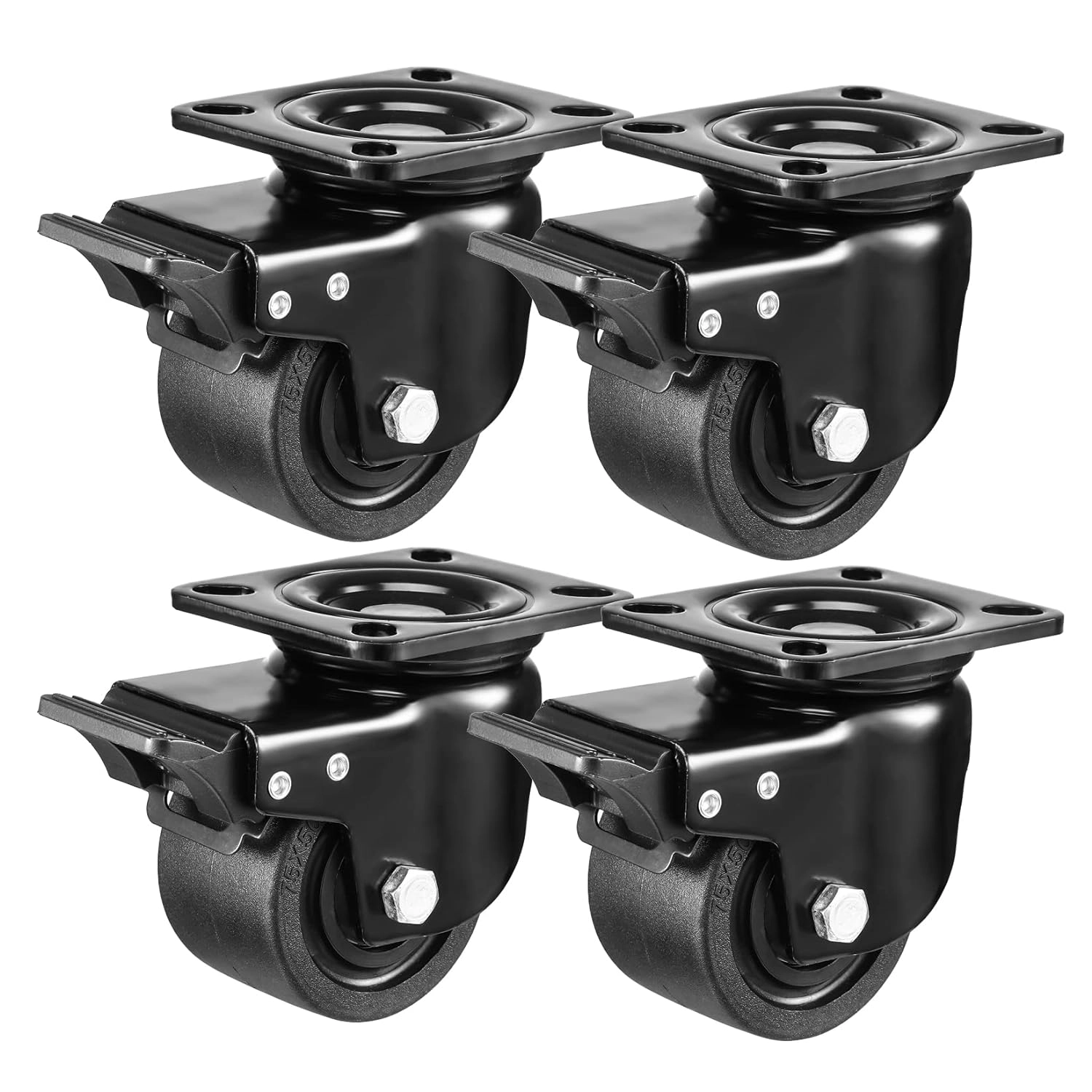
Temporary Fixes and Friction Enhancers (Low-Cost/High-Risk)
Caster Cups and Rubber Coasters
Caster cups rely on a simple mechanism. They create a physical depression and add rubber-to-floor friction. You place the wheel inside the cup to restrict its travel path.
Implementation carries significant risks. Shallow-lipped cups fail under heavy pushback. The wheel simply climbs the lip and rolls out. Felt-bottom cups pose extreme dangers on hardwood floors. They act like sleds. Furthermore, precision docking slows down mobile workflows. Operators waste time aligning wheels perfectly into small cups.
Physical Blocks and Wheel Chocks
Wheel chocks wedge dense material against the tread. They physically arrest forward momentum. While inexpensive upfront, they destroy operational efficiency.
The Total Cost of Ownership (TCO) and ROI drawbacks are severe. You depend entirely on manual labor.
Operators must manually carry heavy blocks between stations.
Workers repeatedly bend down to place them, increasing ergonomic injury risks.
Heavy loads on uneven surfaces often necessitate a second person.
Forgotten chocks lead to immediate safety incidents and workflow bottlenecks.
Retrofitting Existing Equipment (Mid-Tier Interventions)
Floor Locks
Floor locks utilize bolt-on mechanical pads. You engage a foot pedal to press a heavy rubber pad into the floor. This action slightly lifts and stabilizes the cart. It bypasses the wheels entirely.
They offer incredible stability for heavy carts. However, scalability remains a massive issue. They require custom fabrication. They increase total equipment weight. Floor locks also add high initial retrofitting costs per unit. You must install them precisely to ensure level lifting.
Glides (Stationary Footings)
Glides offer a completely different mechanism. You remove the wheel entirely from the socket. You replace the stem with a flat friction pad. This maximizes floor contact area.
This trade-off achieves 100% immobilization. You permanently sacrifice equipment mobility. Glides work perfectly for static furniture. They fail completely in dynamic manufacturing environments. Do not use glides if you need to reposition equipment weekly.
Upgrading to Purpose-Built Caster Wheels
Single vs. Double-Locking Mechanisms
Single brakes, or toe brakes, engage only the wheel tread. They press a metal or plastic tab against the rubber. They suit light office or household applications perfectly. You usually only need to lock two or three wheels to secure a light desk.
Double-locking brakes simultaneously lock both wheel rotation and the swivel bearing. They eliminate swivel shift completely. They are absolutely mandatory for Industrial Caster Wheels. Heavy manufacturing tools and automotive rigs demand them. You cannot risk a heavy load pivoting on its eccentric axis during operation.
Load-Sensing (Reverse Braking) Casters
Load-sensing casters operate on a unique mechanical principle. Wheels roll freely when empty. They instantly lock when weight applies downward force.
This provides the ultimate safety standard. Ergonomic seating requires them to prevent chairs from shooting backward. Step stools and medical utility environments rely on them heavily. They remove the human error of forgetting to engage a manual brake.
Mechanism Type |
Action Controlled |
Best Application |
Safety Rating |
Single/Toe Brake |
Wheel Roll Only |
Home office, light carts |
Moderate |
Double-Locking |
Roll + Swivel Shift |
Industrial loads, workbenches |
High |
Load-Sensing |
Automatic Weight Lock |
Medical stools, safety steps |
Exceptional |
Evaluation Criteria: Choosing the Right Solution
Flooring Constraints & Material Matching
You cannot ignore flooring material. Hard floors like concrete and hardwood demand softer treads. Polyurethane wheels or pure rubber stops provide necessary grip. Hard wheels on hard floors slide uncontrollably.
Carpet environments flip this rule entirely. Carpets require harder wheel treads. Soft rubber bogs down in carpet fibers and restricts deliberate movement. Standard rubber cups prove ineffective on plush carpets. You need spiked cups to penetrate the fibers and grip the subfloor.
Assessing Total Cost of Ownership (TCO)
Buyers often fixate on the initial price tag. You must evaluate the hidden cost of DIY methods. Frequent replacement of duct tape and wooden wedges adds up. Floor damage repairs destroy facility budgets. Safety liabilities from sliding equipment cost thousands in injury claims.
Expense Category |
DIY Hacks & Chocks |
Commercial Lockable Casters |
Initial Purchase |
Low ($10 - $30) |
Moderate to High ($50 - $200) |
Labor Waste |
High (Daily manual adjustment) |
Zero (Foot operated instantly) |
Maintenance/Damage |
High (Scratched floors, worn wedges) |
Low (Occasional lubrication) |
Total 3-Year TCO |
Significantly Higher |
Significantly Lower |
Shortlisting Logic (Next Steps)
Use these rules to shortlist your best solution quickly:
For static home furniture: Invest in heavy-duty, deep-groove rubber caster cups. Do not buy shallow plastic ones.
For medical or caregiver beds: Do not use workarounds. Mandate double-locking or load-sensing wheels to guarantee patient safety.
For warehouse and manufacturing: Upgrade directly to double-locking mechanisms. Eliminate the labor waste of manual chocking completely.
Conclusion
Stopping unwanted movement relies on matching the right friction and locking mechanism to your specific load profile. Temporary fixes might satisfy a short-term need. They ultimately fail under heavy lateral force or sloped conditions.
Assess your actual workflow before purchasing stopgaps. Consider the frequency of movement versus your need for stationary rigidity. If you rarely move the item, glides or heavy cups work well. If you move items daily, built-in double locks save massive amounts of time and labor.
Take action today to secure your environment. Consult a mobility hardware specialist to evaluate your floor type. Browse industrial-grade locking solutions to guarantee zero-compromise safety for your heavy applications.
FAQ
Q: Can you permanently lock a swivel caster?
A: Yes, but DIY methods compromise structural integrity. Drilling holes or using heavy tape often damages the bearing mechanism. Replacing the unit with a double-locking caster is the safest protocol. You can also swap it for a rigid, fixed caster if you no longer need steering capabilities.
Q: Why does my chair still slide when the wheels are locked?
A: You are experiencing sliding, not rolling. The wheel lock successfully prevents axle rotation. However, your floor-to-wheel friction remains too low for the lateral force applied. Upgrading to a softer polyurethane tread or using a high-friction mat solves this issue.
Q: What is the best way to secure wheels on a sloped surface?
A: Caster cups and rubber blocks often fail on inclines due to uneven weight distribution. Directional locking wheels combined with heavy-duty mechanical floor locks provide the best security. They lift the load off the wheels, guaranteeing safety on dangerous gradients.


