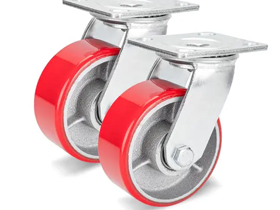
Caster wheels are unique components designed for easy mobility and maneuverability, distinguishing themselves from other types of wheels through their versatile functionality and multi-directional movement. Unlike standard fixed wheels, caster wheels offer rotation and swivel capabilities, allowing objects to be moved in any direction with ease. This makes them ideal for a wide range of applications, from office furniture to heavy-duty industrial machinery. Understanding the key features and benefits that set caster wheels apart from other wheel types can help users select the right wheel for their specific needs and optimize their equipment’s performance. This article will delve into the differences between caster wheels and traditional wheels, explaining their design, functionality, and specific uses in various industries.
Key Differences Between Caster Wheels and Other Types of Wheels
1.Movement Capabilities
Caster wheels are designed to swivel 360 degrees, allowing for multidirectional movement and greater flexibility. This means that caster wheels can change direction with ease, making them ideal for environments where maneuverability is essential, such as warehouses, hospitals, and offices. In contrast, fixed wheels can only move in one direction, typically forward or backward, limiting their ability to turn or navigate tight spaces.
2.Functionality
Caster wheels are built for mobility and stability, allowing items to be moved quickly and easily while maintaining a stable base. They are perfect for dynamic movement, especially when handling bulky or heavy objects. In contrast, other types of wheels, such as rigid wheels, are used for stationary or straight-line movement. Fixed wheels are typically seen in applications where movement is not required, such as on stationary equipment or in areas where equipment remains fixed in place.
3.Load Distribution
One of the distinguishing features of caster wheels is their ability to distribute weight evenly across multiple surfaces. This ensures smoother, more efficient movement, even under heavy loads. Other types of wheels, such as fixed wheels, may focus on handling weight in a more linear direction, which can sometimes create uneven wear or difficulty in maneuvering heavy objects. Caster wheels, by distributing the load, help minimize the risk of damaging surfaces and allow for more controlled movements.
4.Types of Casters vs. Regular Wheels
Caster wheels come in a variety of designs, each suited to specific needs.
Swivel casters offer 360-degree rotation, providing the most maneuverability in tight spaces.
Rigid casters only move in one direction, providing stability and control when directional movement is not necessary.
Ball wheels provide the ability to rotate in any direction, making them ideal for environments where flexibility is needed.
Trolley wheels are often used for lightweight tasks and provide basic, linear motion.
The main difference between caster wheels and regular wheels lies in their ability to rotate and adjust direction, which makes casters far more versatile for a wide range of applications.
5.Application and Versatility
Caster wheels are highly versatile and can be used across a wide range of applications. They are commonly found in industrial settings where equipment needs to be moved around frequently or in medical environments where mobility and stability are crucial. Caster wheels are also widely used in furniture and retail displays where the need for movement is essential. In comparison, other types of wheels like fixed or non-swivel wheels tend to be more specialized and suited to specific, less dynamic tasks, such as providing stability in heavy equipment or serving as stationary supports for objects that do not require movement. Caster wheels' adaptability makes them indispensable for industries requiring regular movement of equipment, goods, and furniture.

Design Considerations for Selecting Caster Wheels
1.Wheel Materials and Their Impact on Performance
The material of the caster wheel affects its performance and durability.
Rubber wheels are great for smooth, quiet movement and are gentle on floors, ideal for indoor use like in offices or hospitals.
Polyurethane wheels are more durable and abrasion-resistant, making them perfect for industrial applications and heavy loads.
Metal wheels, made from steel or stainless steel, are suited for heavy-duty industrial environments, though they can damage floors.
Choosing the right material ensures optimal performance and longer wheel life.
2.Size, Load Capacity, and Swivel Mechanism
The size and load capacity of the caster wheel are crucial in handling the weight of the object. Larger wheels distribute weight better and work well on uneven surfaces.
Load capacity should always exceed the object's weight to avoid damage.
Swivel casters offer 360-degree rotation, ideal for applications requiring flexibility. Rigid casters are better for straight-line movement and provide stability.
Choosing the right size and swivel mechanism ensures efficient operation and mobility.
3.Floor Type and Environment Considerations
The floor type and environment are important in selecting caster wheels.
Soft floors (like carpets) need softer wheels (rubber or polyurethane) to prevent damage and ensure smooth movement.
Hard floors (concrete, tile) need more durable wheels to withstand wear.
For outdoor environments, pneumatic wheels provide better shock absorption on rough terrain.
Indoor use requires quieter, more durable casters for smooth movement.
Choosing the right caster ensures long-term reliability and effective operation in different settings.
Advantages of Caster Wheels Over Fixed Wheels
1.Increased Maneuverability
Caster wheels significantly enhance maneuverability, making it easier to move objects in tight or confined spaces. Unlike fixed wheels, which only move in a straight line, caster wheels can rotate 360 degrees, allowing for smooth, effortless turns and direction changes. This feature is particularly beneficial in environments like warehouses, hospitals, and offices, where objects need to be moved in multiple directions quickly and efficiently. The ability to move in any direction makes caster wheels ideal for environments requiring frequent adjustments or repositioning.
2.Flexibility in Directional Movement
One of the primary benefits of caster wheels over fixed wheels is their flexibility. Fixed wheels only allow for forward or backward movement, limiting their use in situations that require directional changes. In contrast, swivel casters can rotate and adjust to different angles, enabling more control and precision during movement. This flexibility is especially useful in environments with narrow aisles, tight corners, or where frequent direction changes are needed. The 360-degree rotation capability ensures that objects can be moved with minimal effort and greater accuracy, enhancing both efficiency and safety in various applications.
Why Caster Wheels Are Used More Often in Complex Environments
1.Importance in Environments Requiring Frequent Movement
Caster wheels are essential in complex environments like hospitals, warehouses, and retail stores due to their ability to facilitate frequent movement. In hospitals, caster wheels make it easy to move beds, medical carts, and equipment through tight corridors, improving efficiency and reducing physical strain. In warehouses and retail stores, they help quickly transport goods and equipment, enabling smooth workflow and fast rearrangements.
2.Specific Advantages in Flexibility, Maneuverability, and Load-Bearing
Caster wheels excel in providing flexibility and maneuverability, especially in tight spaces. Unlike fixed wheels, casters offer 360-degree rotation, making it easier to navigate corners, aisles, and obstacles. They also support heavy loads and can be equipped with features like locking mechanisms and shock absorption, ensuring stability and safety. This versatility makes caster wheels the ideal solution for handling various types of equipment in demanding environments, where both mobility and load-bearing capacity are crucial.
FAQ
1.Why are caster wheels preferred in hospitals?
Caster wheels are preferred in hospitals because they enable easy movement of medical equipment, beds, and carts through narrow corridors and tight spaces. Their 360-degree rotation allows for precise maneuvering, which is essential in medical settings for ensuring quick and efficient movement.
2.Can caster wheels support heavy loads?
Yes, caster wheels are designed to handle heavy loads, making them ideal for industrial settings and warehouses. They come in various load capacities, and features like heavy-duty construction and shock absorption ensure that they can safely carry significant weight without compromising performance.
3.How do caster wheels improve efficiency in warehouses?
Caster wheels improve efficiency in warehouses by allowing easy and quick transport of goods and equipment. Their maneuverability and swivel capabilities make it easier to navigate through aisles and tight spaces, speeding up operations and reducing manual labor.
4.What are the key benefits of using caster wheels in retail stores?
In retail stores, caster wheels provide flexibility for moving display units, shelving, and products around the store. Their ability to rotate 360 degrees allows for easy setup changes, faster restocking, and efficient store layout adjustments, making them essential for maintaining smooth operations.
Conclusion
Caster wheels are an indispensable tool in complex environments such as hospitals, warehouses, and retail stores, offering unmatched flexibility and maneuverability. Their unique ability to move in all directions enables quick and efficient movement, even in narrow, confined, or crowded spaces where traditional wheels would struggle. By supporting heavy loads and improving workflow efficiency, caster wheels ensure the smooth operation of various types of equipment, from hospital beds and medical carts to industrial machinery and retail displays.
What makes caster wheels even more valuable is their versatility, which includes essential features like locking mechanisms for stability and shock absorption for smooth movement, even over uneven surfaces. These features not only enhance safety but also increase the longevity of both the wheels and the equipment they are attached to. As industries and businesses continue to demand more efficient, reliable, and flexible mobility solutions, caster wheels have become an essential tool in environments that require precision, frequent movement, and easy maneuvering. Their ability to adapt to a variety of applications makes them a crucial element in improving overall productivity and operational success.