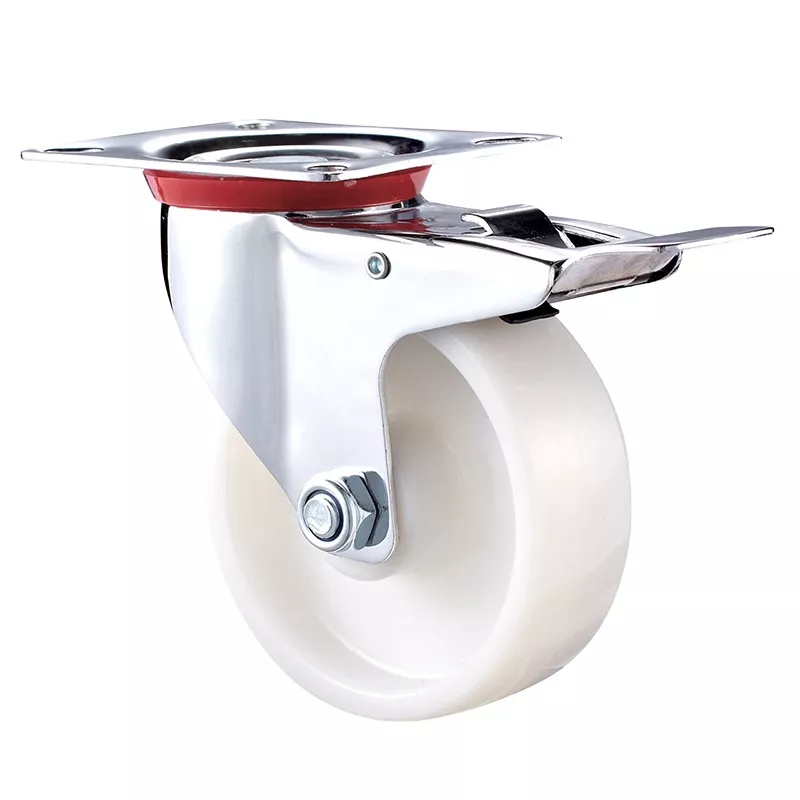
While the basic wheel dates back millennia, the specific engineering of the modern caster—a wheel mounted on a swiveling or rigid rig—is a more recent innovation born out of industrial necessity. The defining 1876 patent by David Fisher set the technical foundation for this mobility solution. However, the technology has drastically evolved from rudimentary furniture movers to highly engineered load-bearing systems used across global supply chains. We must frame this historical evolution not just as trivia, but as a crucial lens for understanding modern material handling. Understanding exactly why historical designs failed—whether through severe floor damage, catastrophic load failure, or poor ergonomics—remains critical today.

Key Takeaways
The modern caster wheel traces its patented origins back to David Fisher in 1876, initially designed for furniture before scaling into heavy industry.
Historical reliance on cast iron and forged steel has shifted to advanced polyurethanes and nylons to solve critical business problems: floor preservation, noise compliance, and ergonomic push/pull strains.
Evaluating modern Industrial Caster Wheels requires moving beyond basic load capacities to assess rolling resistance, environmental durability, and TCO.
Upgrading legacy equipment carries specific implementation risks, particularly regarding top-plate compatibility, mounting standards, and dynamic load safety margins.
The Historical Timeline: Exactly How Old Are Castor Wheels?
Establishing technological maturity and design provenance helps us understand engineering compliance. Engineers and facility managers often view mobility hardware as a static category. Yet, mapping its historical development reveals why modern specifications exist. Before the 19th century, carts relied on fixed axles. These required wide turning radiuses and immense physical effort to maneuver. The fundamental breakthrough required a mechanism capable of independent rotation.
David Fisher secured the pivotal US patent for the first functional furniture caster in 1876. He differentiated the "caster rig" concept from a standard fixed axle wheel by introducing an offset swivel housing. This design allowed the load-bearing component to trail behind the steering axis. It naturally aligned the wheel with the direction of travel. Initially, manufacturers applied this solely to light-duty domestic items like pianos and heavy wooden cabinets.
As the Industrial Revolution accelerated, automated manufacturing and heavy material handling necessitated a massive leap. Factories could no longer rely on fixed-rail trolley systems alone. Assembly lines demanded flexible routing. This required manufacturers to jump from light-duty applications to early rigid and swivel industrial configurations. They began casting heavy iron rigs to support massive forging equipment and textile looms.
Today, we face an interesting reality regarding design stagnation versus modernization. The core physics of an offset swivel lead remain unchanged in over a century. However, the surrounding materials, bearings, and raceway technologies have undergone radical overhauls. A century ago, a raw iron Caster Wheel spinning on a greaseless pin was acceptable. Today, manufacturers must meet stringent ISO and OSHA standards. Modernization focuses entirely on reducing friction, minimizing vibration, and ensuring worker safety under extreme dynamic loads.
The Evolution of Materials: Solving Historical Deficiencies
Early mobility hardware relied heavily on cast iron, forged steel, or raw wood. These materials possessed high compressive strength but lacked elasticity. This created severe operational deficiencies. Heavy iron wheels concentrated massive point loads onto factory floors. They pulverized concrete, splintered wooden decking, and created deafening workplace noise. Furthermore, rigid metal offered zero shock absorption. This transferred all impact forces directly into the cart payload and the bearings, leading to rapid mechanical failure.
Engineers eventually developed distinct solution categories to address these historical failures. Each new material targeted specific operational hazards.
Rubber & Pneumatics: Introduced in the mid-20th century, these materials revolutionized outdoor use. Air-filled pneumatics and solid rubber treads provided essential shock absorption. They protected delicate payloads and allowed carts to traverse uneven gravel or dock plates without tipping.
Polyurethane & Synthetics: This became the modern gold standard. Polyurethane chemically bonds to an iron or aluminum core. It offers the high load capacity of steel combined with the floor protection of rubber. It resists chunking and tearing in debris-filled environments.
Advanced Nylons & Phenolics: Chemical plants and bakeries required different properties. Manufacturers developed high-temperature phenolic resins and glass-filled nylons. These compounds withstand extreme autoclave heat and resist harsh industrial solvents.
We must connect this historical timeline to modern business outcomes. Material evolution directly reduces maintenance downtime. Swapping destructive iron for resilient polyurethane prevents expensive infrastructure wear. You save thousands of dollars in epoxy floor repairs simply by choosing the correct tread durometer.
Historical vs. Modern Material Specifications
Material Type | Historical Era | Primary Benefit | Common Drawback / Limitation |
Cast Iron / Steel | Late 1800s | Extreme load capacity | Destroys flooring; zero shock absorption |
Standard Rubber | 1940s - 1960s | Floor protection; quiet operation | Low weight capacity; leaves scuff marks |
Phenolic Resin | 1970s - 1980s | Chemical resistance; high heat tolerance | Brittle on uneven surfaces; traps debris |
Premium Polyurethane | 1990s - Present | High capacity; floor safe; ergonomic | Higher initial procurement cost |
Assessing Modern Industrial Caster Wheels: TCO and ROI Drivers
Many procurement departments fall into the trap of "commodity" thinking. They treat mobility hardware as cheap, interchangeable components. This mindset is a direct leftover from historical manufacturing eras where hardware was simple and disposable. In modern high-cycle environments, this approach inevitably leads to premature failure. Buying the cheapest option causes cascading costs across your facility.
To move past this trap, evaluate Industrial Caster Wheels using two key evaluation dimensions:
Ergonomics: Measuring the initial push-force required to move a load is non-negotiable. Modern polyurethane treads with precision bearings significantly lower rolling resistance. This directly minimizes workplace injury claims, reduces operator fatigue, and improves overall throughput.
Maintenance frequency: Historical unsealed roller bearings required constant greasing. They trapped dust and moisture, leading to rapid oxidation. Modern sealed precision ball bearings eliminate this maintenance burden. They provide smooth rotation for years without manual intervention.
You can model the Return on Investment (ROI) clearly. Specifying application-matched components carries an upfront premium. However, you must weigh this against the hidden costs of downtime. A failed wheel halts an assembly line. It requires maintenance labor to repair the cart and capital expenditure to resurface gouged floors. Over a three-to-five-year lifecycle, the engineered solution always yields a lower TCO.
TCO Comparison Chart (5-Year Lifecycle Estimate)
Cost Factor | Commodity / Legacy Design | Engineered Industrial Spec |
Initial Unit Cost (Set of 4) | $40.00 | $180.00 |
Replacement Frequency | Every 8-12 months | Every 4-5 years |
Maintenance Labor (Greasing) | $200.00 (Annually) | $0.00 (Sealed Bearings) |
Floor Damage Repairs | High probability | Zero to low probability |
Estimated 5-Year TCO | $1,200.00+ | $180.00 |
Decision Framework: Specifying the Right Caster Wheel Today
Selecting the proper mobility solution requires a structured approach. You cannot simply read a load capacity label and place an order. Legacy upgrades demand rigorous shortlisting logic. Follow this step-by-step matrix to narrow down modern options.
Step 1: Environmental Audit. Assess your operating conditions before looking at catalogs. Identify temperature extremes, such as commercial freezers or baking ovens. Note any chemical exposure, oil spills, or strict washdown requirements. Corrosive environments dictate stainless steel rigs and nylon treads, ruling out standard zinc-plated iron.
Step 2: Dynamic vs. Static Load. Historical spec sheets often fail here. A static load is a cart sitting still. A dynamic load involves a cart moving over uneven terrain or dock plates. Shock loading forces multiply the weight exponentially. Always multiply your maximum expected load by a safety factor of 1.3 to 1.5 to account for these kinetic forces.
Step 3: Floor Surface Matching. Hard floors require soft wheels, and soft floors require hard wheels. You must pair the tread hardness, known as durometer, to your specific flooring. Use softer polyurethanes for smooth epoxy to gain grip and reject debris. Use harder phenolics for thick carpets or metal grating.
Once you determine the core specs, evaluate modern feature requirements. Legacy models lacked advanced safety integrations. Today, you can specify total-lock brakes that secure both the swivel raceway and the wheel simultaneously. You should also consider toe guards to prevent foot injuries in tight warehouse aisles. For aerospace or delicate electronics handling, independent suspension systems isolate the payload from high-frequency vibrations.
Implementation Risks: Upgrading Legacy Equipment
Retrofitting carts designed decades ago with modern hardware presents significant physical and operational challenges. You cannot expect a seamless "plug-and-play" experience. Engineering teams must document rollout lessons and mitigate specific risks before executing a full fleet upgrade.
Dimensional incompatibilities cause the most frequent headaches. Over the decades, mounting bolt hole patterns have standardized, but legacy carts often feature proprietary spacing. Forcing a mismatched top plate onto an old cart compromises structural integrity. Furthermore, you must scrutinize the Overall Height (OAH). If the new assembly is even half an inch taller or shorter than the original, it alters the cart's ergonomics. Mismatched OAH across a single cart causes wobbling, immediately creating a dangerous tip-over risk. Stem size variations in scaffold or tube carts also require precise caliper measurements before ordering.
You must also calculate center of gravity shifts. Changing the wheel diameter or increasing the rig width alters the dynamic stability of legacy equipment. A cart handling tall, top-heavy payloads might become dangerously unstable if you widen the swivel radius without adjusting the cart's base footprint.
Always undertake specific next-step actions to ensure safety. We highly recommend running engineering pilots. Audit your current fleet thoroughly. Request 3D CAD files from your supplier to conduct digital integration testing. Finally, run push/pull dynamometer tests on a single retrofitted prototype before approving full-scale procurement. This proves the ergonomic ROI to management using empirical data.
Conclusion
The caster wheel may be over 140 years old, but its transition from a simple furniture mobility device to a highly engineered industrial component fundamentally changes how it must be evaluated. We can trace its lineage from David Fisher's swiveling patent to today's polyurethane and independent suspension systems. This evolution reflects the increasing demands of global supply chains, worker safety regulations, and infrastructure preservation.
Successful procurement relies heavily on matching modern material science to specific operational environments. You cannot simply replace "like for like" when upgrading legacy carts. Doing so perpetuates historical flaws and ignores decades of ergonomic advancements. Focusing on TCO, bearing styles, and dynamic load factors ensures your fleet operates efficiently.
Take action on your next maintenance cycle. Encourage your purchasing buyers to consult directly with application engineers. Request sample testing for your specific floor conditions, or utilize digital configuration tools to accurately spec your next fleet upgrade. Proper specification protects your payload, your floors, and your workforce.
FAQ
Q: Who invented the first caster wheel?
A: David Fisher invented the first patented caster wheel in 1876. He secured a US patent for a furniture mobility device that utilized a unique swivel housing. This offset design allowed the wheel to trail behind the turning axis, enabling smooth, independent directional changes without lifting the load.
Q: Why is the spelling "castor" vs "caster" used interchangeably?
A: The variation stems primarily from regional and linguistic differences. "Caster" is the standard American English spelling for the wheeled mobility device. "Castor" is more commonly used in British and Commonwealth English. Both terms refer to the exact same technical component in industrial engineering contexts.
Q: How long should modern industrial caster wheels last?
A: Lifespan depends entirely on application variables like cycle counts, load adherence, and environment. A properly specified polyurethane wheel with sealed precision bearings can easily last 3 to 5 years under heavy daily use. This contrasts sharply with misapplied legacy hardware, which often fails within months.