Removing a damaged or seized caster wheel is rarely a clean or straightforward process. Whether you are dealing with hidden stems buried in an office chair or rusted plate bolts on heavy warehouse carts, improper removal often leads to permanently damaged mounting points. This translates directly into unnecessary equipment downtime and frustrating repair delays. We built this guide to provide a structurally sound, step-by-step framework to help you safely extract stubborn casters without compromising the equipment base. We will then walk you through an evidence-based framework for specifying the exact correct replacements. By mastering these maintenance procedures, facility managers and DIYers alike can avoid costly mistakes. Efficient removal and intelligent replacement specification directly reduce the Total Cost of Ownership (TCO) for both material handling fleets and general office infrastructure. You will learn to work smarter, not harder.
Key Takeaways
Tooling dictates success: Attempting removal without proper leverage tools (flathead screwdrivers, channel lock pliers, or penetrating oil) increases the risk of stripping threads or warping stems.
Identify before you pull: Applying rotational force to a press-fit grip stem—or pulling linearly on a threaded stem—will damage the mounting socket.
Plan for the worst: Allocate 15–20 minutes for penetrating oil to act on rusted or seized industrial connections before escalating to destructive removal methods.
Upgrade strategically: The removal process is the optimal time to evaluate failure causes and upgrade to a Caster Wheel specification that matches your actual floor conditions and load requirements.

Pre-Removal Setup: Risk Mitigation and Tooling
Removing heavy-duty or industrial casters poses serious safety risks. You can severely damage the underlying cart, rack, or chair if you do not stage the equipment properly. Many people rush into the removal phase. They flip a heavy cart over and immediately start hammering. This approach often bends the frame. It also invites personal injury.
Safety & Staging Protocols
Proper staging prevents center-of-gravity shifts. You must isolate the wheel before applying mechanical force.
Empty the equipment payload entirely. You do not want heavy items shifting while you work.
Invert the equipment if it is light enough. If it is too heavy, securely block the frame. Ensure zero weight rests on your target wheel.
Wear required Personal Protective Equipment (PPE). Industrial environments mandate safety glasses. Metal grip rings can snap and fly outward. Cut-resistant gloves protect you from sharp, rusted edges.
The Core Toolkit
You need the right tools to break friction seals and turn rusted bolts. Substitute tools often strip metal components.
Flathead screwdrivers and small pry bars. They provide essential leverage for press-fit stems.
Channel lock pliers and vice grips. You will need them to grab stripped collars or smooth surfaces.
A rubber mallet. It delivers non-marring impact to dislodge stuck assemblies.
WD-40 or industrial penetrating oil. Chemical release is vital for seized connections.
Step 1: Identify Your Caster Wheel Mounting System
Diagnose the mount type before you apply any force. Misidentifying the mount causes most stripped sockets and structural damage. Pulling on a threaded stem destroys the internal threading. Twisting a press-fit stem wastes your energy.
Mount Type | Visual Identifier | Primary Removal Action |
Plate-Mounted | Square/rectangular metal plate with four bolts. | Unbolting (Counter-clockwise) |
Stem-Mounted (Grip) | Metal stem inserted into a socket. No visible threads. | Pulling / Prying |
Stem-Mounted (Threaded) | Looks like a bolt protruding from the housing. | Unthreading (Counter-clockwise) |
Bolt-Hole (Kingpin) | A single bolt passes through the center raceway. | Unbolting (Counter-clockwise) |
Plate-Mounted Casters
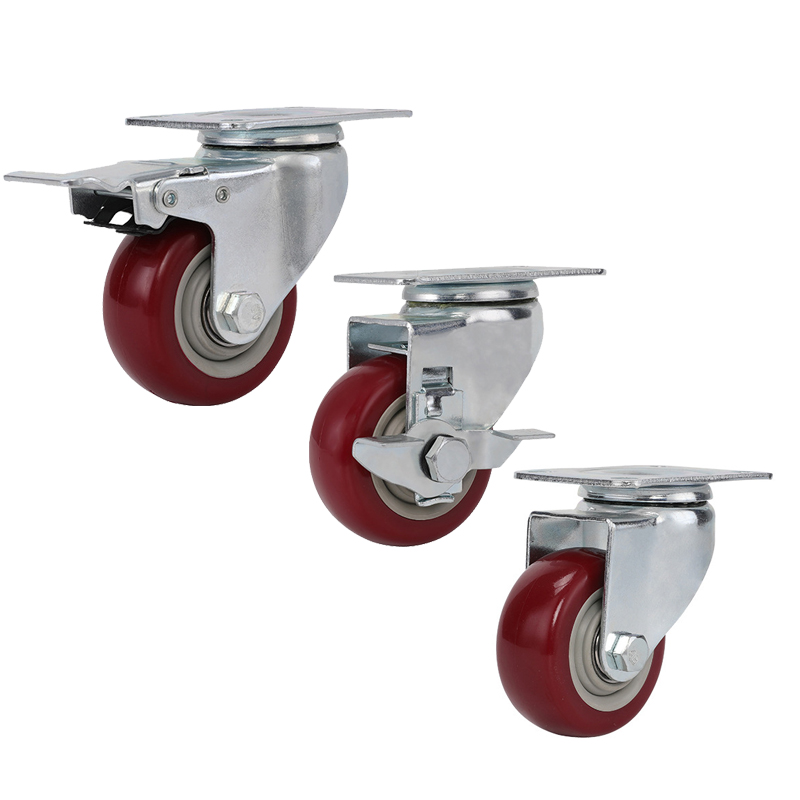
You can recognize these by a square or rectangular metal plate. Four bolts or screws secure this plate to the equipment. This design distributes heavy loads over a wider area. You will commonly find them on Industrial Caster Wheels and heavy-duty carts.
Stem-Mounted Casters (Three Sub-types)
Stem mounts insert directly into a leg or base. They fall into three distinct categories:
Grip Ring / Grip Neck: This features a small metal compression ring near the top. It operates on a simple press-in, pull-out friction mechanism. It has no threads.
Threaded Stem: This resembles a traditional bolt. The stem protrudes from the caster base. You must unthread it to remove it.
Open Socket / Stemless: The metal stem stays permanently inside the furniture base. The plastic wheel assembly simply snaps off the bottom.
Bolt-Hole (Hollow Kingpin) Casters
You can identify a bolt-hole mount by a single central bolt. This bolt passes directly through the center of the swivel raceway. It tightly clamps the wheel housing to the equipment leg.
Step 2: Execution SOPs by Mount Type
You must follow the specific pathway dictated by your mount identification. Applying the wrong directional force guarantees component failure. Below are the Standard Operating Procedures (SOPs) for each system.
Removing Plate-Mounted Connections
These require standard hand tools. Corrosion often complicates the process.
Select an appropriate socket wrench. Fit it over one of the four corner nuts or bolts.
Turn the wrench counter-clockwise to loosen the hardware.
Address spinning bolts immediately. Sometimes the entire bolt spins freely. Secure the top nut with a crescent wrench while you loosen the bottom bolt.
Remove all four fasteners and lift the metal plate away from the frame.
Removing Stem-Mounted Connections
Your technique depends entirely on the stem sub-type. You cannot treat grip rings and threaded stems the same way.
Grip Ring (Press-Fit): Insert a flathead screwdriver between the caster base and the equipment frame. Twist the screwdriver gently to break the friction seal. Grab the base firmly. Pull outward while utilizing a side-to-side wiggle motion.
Threaded Stem: Look for an integrated hex nut just above the wheel swivel. Use a thin wrench on this nut. Turn it counter-clockwise. If no nut exists, clamp channel lock pliers onto the thickest part of the collar. Unthread the assembly completely.
Removing Bolt-Hole Connections
These single-bolt systems require stabilization before you twist.
Secure the main housing with one hand so it cannot spin.
Access the center bolt. You will find it either underneath the wheel or running down through the hollow kingpin.
Use a socket or hex key. Unthread the bolt counter-clockwise until it detaches.
Troubleshooting: Dealing with Seized, Rusted, or Stripped Casters
Factory environments and humid conditions cause a phenomenon called galvanic corrosion. Metal-on-metal components effectively fuse together over time. Implementation realities dictate that brute force often breaks the equipment before the Caster Wheel gives way.
Chemical Release (The 20-Minute Rule)
Do not hammer a rusted stem immediately. Apply penetrating oil directly into the stem cavity. You can also spray it heavily onto rusted plate bolts. Allow 15 to 20 minutes of dwell time. The chemicals need this window to break down rust bonds. Re-attempt your removal process only after the oil penetrates.
Mechanical Escalation for Stripped Components
Sometimes hardware degrades beyond normal tool usage. You must escalate your mechanical approach safely.
If a threaded collar is stripped: Clamp vice grips as tightly as possible around the metal base. This provides maximum leverage when wrench flats wear down.
If a grip stem is completely seized: Place a chisel at the junction point between the wheel base and the frame. Strike it sharply with a hammer. Drive it out incrementally to avoid warping the receiving socket.
Post-Removal Checklist
Never install new wheels without checking the mounting area. A compromised base will ruin your new hardware.
Inspect the receiving socket for micro-fractures or structural splitting.
Check plate mounting holes for severe rust deterioration.
Verify holes are not widened or wallowed out.
Clean the entire mounting area thoroughly to ensure a flush, secure fit.
Post-Removal Evaluation: Specifying Your Replacement Caster Wheels
Do not reflexively buy the exact same unit if the previous one failed prematurely. You must evaluate the root failure mode. Selecting a smarter replacement lowers your long-term maintenance costs. This decision-stage logic separates professional fleet management from amateur repairs.
Measurement Standards
Precision is non-negotiable for stem mounts. You must strictly measure the stem diameter and length. A standard office chair usually takes a 7/16" x 7/8" stem. If you buy a stem that is one millimeter too narrow, it will cause fatal wobbling. If it is too wide, it will fail to seat entirely. Use digital calipers for exact dimensions.
Evaluation Dimensions for Upgrading
Assess your operational environment. Use these three dimensions to choose a superior replacement.
Load Capacity & Scalability: Did the bearings shatter? Did the rig bend? Upgrade to Industrial Caster Wheels. Look for forged steel rigs. Ensure they offer much higher static and dynamic load ratings.
Floor Compatibility: Hard plastic wheels destroy soft flooring. Replace them with polyurethane or non-marking rubber. This simple swap eliminates floor gouging. Floor repair costs drive up your TCO significantly.
Maintenance Requirements: Unsealed roller bearings trap dirt and hair. Consider sealed precision ball bearings instead. You might also move from a high-maintenance twin-wheel design to a low-maintenance single-wheel design.
Failure Symptom | Probable Cause | Recommended Upgrade Feature |
Shattered Wheel Hub | Dynamic load capacity exceeded. | Forged steel core or solid polyurethane. |
Scratched Floor Surfaces | Hard nylon/plastic material. | Soft polyurethane or TPR rubber treads. |
Stuck/Jammed Swivel | Debris entanglement in bearings. | Sealed precision ball bearings. |
Bent Mounting Plate | Impact shock / Overloading. | Thicker gauge steel top plate (1/4" or more). |
Next-Step Actions
Audit your entire fleet before ordering parts. You should always replace all four units simultaneously. Mixing old and new wheels creates uneven load distribution. It also increases rolling resistance and causes tracking issues. Uniformity ensures your equipment glides safely.
Conclusion
Successful extraction relies on process, not just brute force. Always identify your mount type first. Apply the correct directional force based on whether you need to pull or twist. Utilize leverage and penetrating lubrication for seized units. Finally, inspect the structural integrity of the base before reassembly.
A successful removal is only half the process. Upgrading to a properly specified wheel prevents you from repeating this frustrating process next quarter. You must match your new hardware to your actual floor conditions and weight capacities.
Take action today. Consult your equipment's technical specifications. Utilize a trusted dimension matching guide to confirm your stem sizes. Contact a technical sales engineering team if you need bulk industrial replacement recommendations for your facility.
FAQ
Q: Can I remove press-fit caster wheels without specialized tools?
A: Yes. While pry bars are ideal, you can often break the grip ring's friction hold manually. Aggressively wiggle the base side-to-side while applying steady, downward pulling pressure. You might need to use a thick towel to improve your grip on the smooth plastic.
Q: How do I know if my caster failure requires a heavy-duty industrial upgrade?
A: Look for flattened wheels, also known as flat-spotting. Check for shattered raceways or severe wobbling during movement. These symptoms clearly indicate your application repeatedly exceeded the previous unit's dynamic load rating. An industrial-grade upgrade is necessary.
Q: Can I replace a single-wheel caster with a twin-wheel caster (or vice-versa)?
A: Yes. You can switch styles provided the mounting mechanism exactly matches. The plate dimensions or stem sizes must be identical. Furthermore, the overall mounting height must remain consistent. Changing heights on just one wheel will destabilize the entire piece of equipment.