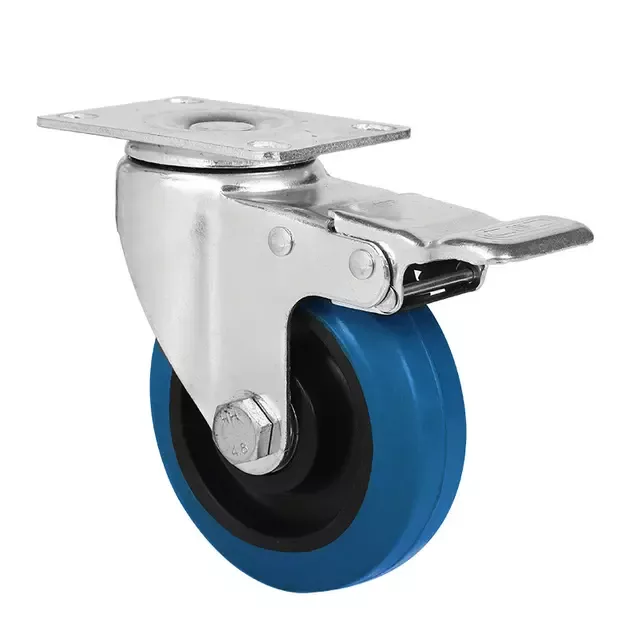
Improper load calculations carry massive hidden costs. Premature bearing failure, severe floor damage, and catastrophic equipment breakdowns constantly drain operational budgets. Facilities often ignore these subtle risks until unexpected downtime strikes. Specifying the correct heavy-duty Caster Wheel requires much more than simple division. Engineers must strictly account for dynamic impact forces, inevitable floor anomalies, and complex material physics. Everyday industrial environments present highly unpredictable variables. A slight mathematical miscalculation easily compromises an entire logistics fleet.
We provide a definitive, engineering-backed guide to calculating precise load limits. You will learn to integrate necessary safety multipliers effectively. We will also help you navigate standard industry compliances. By mastering these core mechanical principles, you ensure long-term equipment reliability. Ultimately, this proactive approach protects your total cost of ownership and worker safety.
Key Takeaways
The "N-1" Standard: Never divide total weight by the total number of wheels. Always subtract one wheel (N-1) to account for uneven floors where one wheel inevitably floats.
Safety Multipliers Matter: For critical industrial applications, apply a 33% to 50% safety buffer (a multiplier of 1.33 to 1.5) to your base weight requirements.
Shock Loads Change the Math: Applications involving thresholds or debris require dividing total weight by 2 (instead of 3) to survive impact forces.
Physical Dynamics: A caster wheel’s capacity is heavily dictated by its mounting type (plate over stem) and tread profile (flat tread carries more than round, but sacrifices maneuverability).
The Business Cost of Underestimating Caster Load Capacity
Slightly underspecified casters rarely break immediately. Instead, they dramatically increase rolling resistance across your facility. This extra friction severely drains battery life on automated guided vehicles (AGVs). It also significantly increases manual worker fatigue. Teams lose momentum and productivity when pushing overloaded carts. Your total cost of ownership (TCO) spikes due to frequent component replacements. You end up spending triple the initial purchase price on maintenance labor alone.
Static load risks represent another major hidden hazard. The "flat spot" phenomenon occurs when stationary equipment sits under excessive weight. Leaving equipment stationary while overloaded permanently deforms the tread structure. Soft rubber yields and flattens when overloaded by just 50%. Polyurethane structures deform permanently when overloaded by 60%. This deformation ruins the wheel structure entirely. You cannot repair a flattened tread. The cart will bounce violently once it resumes motion.
Load capacity directly impacts workplace safety and liability. Overloaded setups frequently lead to sudden pivot failures. They create severe tipping hazards during heavy transport tasks. A collapsed cart endangers nearby personnel instantly. We must treat load capacity as a critical OSHA compliance issue. Proper calculations prevent catastrophic facility accidents. Protecting human operators remains your highest daily priority.
Common Mistake: Procurement teams often buy based on the average payload rather than the absolute maximum payload. This oversight virtually guarantees premature equipment failure during seasonal production peaks.

The Standard Industry Formulas for Caster Weight Limits
Industry professionals rely heavily on the "N-1" rule. This core formula determines safe individual wheel capacities accurately.
Equation: Required Capacity per Wheel = (Equipment Empty Weight + Maximum Payload) / (Total Casters - 1)
Why is this standard practice globally? It acknowledges the physical reality of uneven warehouse floors. Three wheels usually bear the full load. The fourth wheel inevitably hovers slightly above the ground. You risk overloading the active wheels if you simply divide by four.
Global engineers sometimes use an alternative safety factor calculation.
Equation: Required Capacity = (Total Weight / Number of Casters) * Safety Factor (1.3 to 1.5)
This method adds an explicit percentage buffer. It multiplies the base requirement rather than subtracting a wheel. You gain a 30% to 50% capacity cushion immediately. This robust buffer handles unexpected floor dips perfectly. Asian and European engineering standards frequently favor this specific multiplier method.
Non-standard cart configurations require completely different math. Platform carts using six wheels need special attention. The two center pivot casters bear immense operational stress. They must handle a minimum of 50% of the total gross weight. Three-wheel carts present another unique physical challenge. Each individual caster must support at least 40% of the total load.
Cart Configuration | Calculation Method | Primary Engineering Rationale |
Standard 4-Wheel Cart | Total Weight / 3 | Accounts for one wheel floating on uneven concrete surfaces. |
6-Wheel Center Pivot | Center Wheels = 50% of Total Weight | Center wheels act as the primary pivot fulcrum during turns. |
3-Wheel Cart | Total Weight * 0.40 (Per Wheel) | Triangular load distribution concentrates stress heavily on single points. |
Dynamic, Static, and Shock Loads: Contextualizing Your Environment
Environments dictate exactly how loads behave mechanically. We evaluate capacity across three distinct physical load states. Static load defines the weight capacity when equipment remains entirely stationary. This specific rating is usually much higher than dynamic limits. Dynamic load represents the safe operating capacity at standard walking or towing speeds. Shock or impact loads involve sudden kinetic force spikes. These dangerous spikes occur from drops, floor thresholds, or deep potholes.
Shock environments change the mathematical rules fundamentally. Engineers follow a strict rule-of-thumb for rough terrain. Do you expect high impact forces? You must divide the total weight by two rather than three. This specific calculation finds the true safe minimum capacity. Impact spikes easily double the normal operating stress instantly. You need this extreme structural buffer to survive harsh manufacturing facilities.
Procurement teams must verify vendor claims strictly. We advise looking for standard ANSI ICWM testing guidelines. Reputable manufacturers test against these rigorous industry benchmarks. Validated test data proves actual field reliability.
ANSI ICWM Stress Test Benchmarks
Dynamic Test: Wheels must survive extensive obstacle courses under full rated weight without structural degradation.
Impact Test: Casters must survive sudden drops carrying two times (2x) their rated target weight.
Static Test: Casters must withstand continuous pressure of four times (4x) their rated weight without yielding.
Best Practice: Always demand the official ANSI ICWM testing certificate from your supplier. Marketing brochures often inflate capacity numbers loosely. Laboratory test documents reveal the true engineering limits.
Physical Factors That Dictate Industrial Caster Wheel Capacity
Specifying Industrial Caster Wheels often comes down to material and mounting choices. Material selection establishes your absolute weight ceiling. Forged steel and cast iron offer maximum theoretical capacity. However, they easily destroy untreated concrete floors over time. High-grade polyurethane (PU) offers an excellent practical compromise. It balances heavy-duty capacity and essential floor protection perfectly. Soft rubber possesses the lowest capacity threshold overall. Yet, it delivers superior vibration dampening for highly fragile cargo.
Tread profiles force specific performance trade-offs continually. We must compare flat treads versus round (donut) treads. Flat treads distribute heavy weight over a much wider surface area. They achieve a significantly higher capacity rating naturally. For example, a heavy-duty flat tread carries 600 lbs effortlessly. A round tread of the exact same size carries only 450 lbs. Round treads, however, offer better ergonomics and much easier manual turning.
Mounting architecture dictates long-term structural endurance. Top-plate mounts inherently outperform stem mounts in heavy applications. Plate mounts distribute dynamic loads evenly across the entire mounting surface. Stem mounts concentrate extreme stress into a single narrow insertion point. A snapped stem causes immediate cart collapse.
Additionally, we must carefully consider swivel versus rigid frames. Rigid fixed forks naturally maintain higher structural integrity under extreme loads. Swivel yokes contain complex rotating ball bearings. These bearings introduce mechanical vulnerabilities under massive weight. Engineers often combine two rigid and two swivel casters. This setup balances high capacity limits with necessary directional maneuverability.
Tread Material | Capacity Range | Best Application Scenario |
Forged Steel / Cast Iron | Extremely High (2000+ lbs) | Stationary machinery or steel-plated factory floors. |
Polyurethane (PU) | High (1000 - 2000 lbs) | General manufacturing, AGVs, and clean warehouse concrete. |
Soft Rubber | Low to Medium (Under 500 lbs) | Transporting fragile electronics or navigating uneven outdoor asphalt. |
A 5-Step Evaluation Framework for Specifying the Right Casters
Selecting the correct components requires a systematic engineering approach. Follow this proven five-step implementation framework precisely.
Step 1: Gross Weight Assessment
Calculate the maximum payload plus the cart's empty tare weight. Do not rely on average or estimated loads. Always plan for the absolute heaviest operational scenario. If workers occasionally stack extra boxes, calculate that extra weight immediately. Underestimating the gross weight invalidates all subsequent engineering math.
Step 2: Determine Load Distribution Strategy
Decide between a standard four-wheel design, a six-wheel center pivot, or specialized track setups. Base this decision entirely on your facility maneuverability needs. Tight aisles often require six-wheel center pivot designs. Open warehouse floors accommodate standard four-wheel setups easily. Match the configuration to the physical constraints of your building.
Step 3: Factor in Environmental Multipliers
Adjust your baseline math for harsh facility conditions. Caustic chemicals, extreme temperature swings, and rough concrete degrade materials rapidly. These severe hazards lower the effective long-term capacity. If you operate in a freezing environment, rubber hardens and shatters. You must select specialized cold-rated polyurethane to maintain your required weight limits.
Step 4: Select Wheel Physics
Match the material, diameter, and width to your required capacity threshold. Follow a basic engineering rule of thumb. Rougher floors always require larger diameters and thicker tread profiles. A larger wheel rolls over debris much easier. It distributes the crushing weight over a larger physical contact patch.
Step 5: Shortlist and Verify Specs
Audit vendor documentation carefully before purchasing. Ensure the quoted capacity applies strictly per individual wheel. Novice buyers often mistake multi-pack set ratings for single-unit limits. If a box of four says "1000 lbs", each wheel likely only holds 250 lbs. Always demand clarification from your supplier on specific load ratings.
Conclusion
Determining the weight limit requires rigorous worst-case scenario planning. Basic math falls short in highly unpredictable industrial spaces. Your chosen formulas must account for uneven floors and dynamic impact variables. We recommend three immediate action steps. First, consult an engineering specialist to audit your current equipment fleet. Second, request specific ANSI test data from your supply partners. Finally, utilize an interactive load calculator to spec your next project safely. Proper planning today prevents catastrophic operational failures tomorrow.
FAQ
Q: Is the weight capacity of a caster rated per wheel or per set of four?
A: The industry standard dictates rating capacity per individual caster. However, buyers must never multiply this single rating by four for a standard cart. Always multiply the individual capacity by three. This N-1 adjustment accounts for uneven floor distribution where one wheel frequently hovers above the ground.
Q: Why do caster wheels develop flat spots if the cart isn't moving?
A: Flat spots result directly from continuous static overload. A stationary cart exceeding its material limits permanently damages the tread. If weight exceeds 50% of the overcapacity limit for soft rubber, the material yields. Polyurethane deforms at 60% overcapacity. You must always factor in a substantial static load buffer.
Q: Can I just buy larger diameter wheels to increase load capacity?
A: Generally, yes. A larger wheel diameter naturally increases overall load capacity. It distributes the heavy weight over a much larger surface area. This assumes the core material and internal bearings remain identical. Wider treads also contribute to higher capacity ratings while improving structural stability over rough terrain.